Part 0b: Getting Started!
- Thomas Watteyne
- Keoma Brun
Goal
Overview of the hardware you will be using, and of the general organization of the unplugfest.
Hardware lineup
During the session, you will form groups of 4-6 people. Each group will receive a complete kit with one manager and 5-6 motes.
Devices come in different shapes and sizes:
|
| line-up of the devices you will be using |
|---|
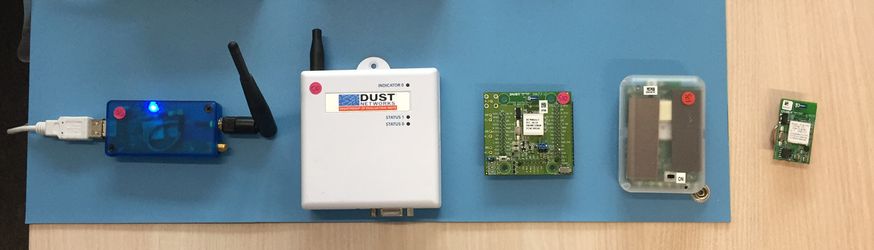
From left to right:
| name | role | commercially available? | description |
|---|---|---|---|
| DC2274 | manager | yes, http://www.linear.com/solutions/5744 | the device which connects your SmartMesh IP network to the Internet (a.k.a. "gateway", "sink", etc) |
| "white box" | mote | no, this is a home-made device. It is not (and will not be) commercial available. | a mote powered by a 2200mAh TADIRAN battery, in a box |
| DC9003 | mote | yes, http://www.linear.com/solutions/3106 | a mote powered by a 225mAh CR2032 coin-cell battery |
| DC2126A | mote | yes, http://www.linear.com/solutions/5320 | a mote powered by a combination of a solar cell (when there is light) and battery (when there is no light), attached to a thermistor |
| LTP5901 module | mote | yes (http://www.linear.com/product/LTP5901-IPM) but without the battery holder on the back | a mote powered by a 1000mAh CR2477 coin-cell battery |
manager? mote?
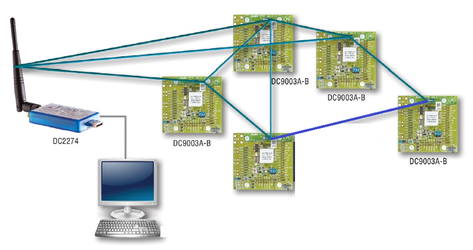
- the "manager" is the gateway device which sits at the edge of your low-power wireless network, typically connected to a computer.
- a "mote" is a device which is deployed in the field and typically attached to sensors and actuators.
Together, the manager and motes form a low-power wireless mesh network around the manager:
Motes are equivalent
While motes differ in the sensors and actuators attached, the power source and packaging, they are equivalent from a networking point of view. That is, the same LTC5800 system-on-chip is at the heart of each device, and implements the same networking software.
Each network is self-contained
Each group starts off with an entirely self-contained network, which includes one manager and a number of motes. Even though you might be sitting in the same room as another group, networks are independent.
Accounts and Credentials
Your instructor will have set up a number of services running in the IBM Cloud, including an instance of the IBM Watson IoT Platform.
You will receive at the beginning of the session the following credentials:
Ideal Classroom Setup
Each group has a standalone network. Each group ideally has a separate table. The instructor runs yet another network.
Answer sheet
The instructions contain questions which allow the instructors to verify you are moving along well. Write down the answers to those questions on a sheet of paper as you move along.